Opportunities in fertilizer prilling
J. Kilian Schnoor, Kreber, The Netherlands, explores how prilling is helping adapt, change and innovate fertilizer production.
The first prill
According to legend, a plumber named William Watts from Bristol, UK, had an intriguing experience. One night, after many ales, he found himself near a Church, where he had contributed to renovating the lead roof. Exhausted and ruminating on his wife's disappointment at his late return, he dozed off on a bench. In his dream, his wife's anger manifested, and she poured molten lead down the church tower, shaping it into perfect spherical droplets that rained upon him. Awakening, he realized it was merely rain falling on him. [1]
Curiosity piqued, he and his wife ascended the church roof the next day. With a drilled cooking pan and molten lead, they replicated the dream's scenario. Just as in the dream, the lead formed spherical droplets, which solidified into the perfectly round first lead prills. In 1782, these became known as patent lead shot, revolutionizing shotgun ammunition. Convinced of his method, Watts constructed the world's first prilling tower atop his house a few years later. [2]
Since then prilling has seen many innovations which have matured it into an industrial scale production technology that allows to produce tons of prills per hour. Now, prilling provides great control on the process parameters, product shape and size. Through prilling technology fertilizers, but also plastics and fine chemicals, seen in figure 1, benefit from these advantages. Prilling provides fertilizer production with an easy to use and stable finishing technology that can operate in a wide range and results in a free flowing product with a narrow particle size distribution.
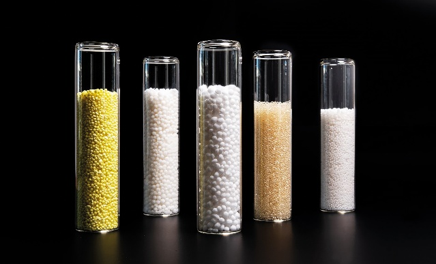
Figure 1: Sample of prills from, left to right: sulfur, urea, ammonium nitrate, bisphenol A, benzoic acid.
Challenges today are very different from those in 1782, when the first prilling technology was patented. How will prilling adapt, change and innovate fertilizer production as well as upcoming technologies and production processes to continue to be the solution engineers and scientists have dreamt of?
Growing healthy crops
Fertilizers help overcome deficiencies that crops face today. They help the plant to obtain an adequate supply of nutrients to promote their growth and development. Without fertilization the plants productivity and fertility decrease which leads to stunted growth, death of plant tissue, or yellowing of the leaves. This effects agriculture through reduced crop yield or plant quality. Nutrient deficiency also aggravates the reduction of biodiversity.
Fertilizer prills supply two classes of nutrients to plants: macronutrients and micronutrients. Macronutrients are the building blocks of crucial cellular components like proteins and nucleic acids. Nitrogen, phosphorus, magnesium, and potassium are some of the most important macronutrients. Micronutrients, including iron, zinc, manganese, and copper, are required in smaller amounts. Nutrients are usually obtained from the soil through plant roots. Over the last years and decades many nutrients have decreased and are not available in sufficient amounts in the soil and need to be added to allow viable plant growth and crop yield. [3]
To ensure continuous nutrient supply fertilizers itself also need to meet the requirements of a changing climate, being more resistant to higher humidity, higher temperatures, more intense rainfall as well as stronger winds. By understanding the challenges and developing strategies with the right finishing technology and fertilizer mixture we can cope with these obstacles now and in the future. [4]
Regulations and changing climate
Through agriculture 10.3 % of EU’s greenhouse gas (GHG) emissions in the EU are emitted because of the use of fossil energy in the value chain. With 70% coming from non-CO2 GHG emissions, mainly nitrous oxides and methane. The European Commission (EC) commits to reduce GHG emission by 55 % (compared to 1990) in 2030 and by 100 % in 2050. To reduce environmental impacts of fertilizer overuse the EC will set new rules. As a result, fertilizer companies must comply with increasingly stringent environmental regulations, which influence production costs and limit the availability of certain types of fertilizers. Organic fertilizer use has been identified as an attractive alternative that has been formally adopted under EC’s Green Deal. Reduction of nitrogen use from 100 kg/ha to 20 kg/ha is an estimated goal for more sustainable farming. With effective and innovative fertilizer management sustainable farming can reach average crop yields of conventional farming while using significantly less nitrogen fertilizer. [4], [5]
Urea prills are one of the most common nitrogen fertilizers, unfortunately it has a lower field-yield efficiency and a higher carbon footprint when compared to other nitrogen fertilizer products. The agricultural outlook of the Food and Agriculture Organization (FAO) of the UN projects that a fertilizer price increase caused by higher fossil energy prices leads to a direct price increase of agricultural products. This mainly influences growth and wealth of developing countries where household spend is up to 25 % on food and people can’t afford a further price increase. In contrast, there is an estimated growth in food consumption by 1.3 % over the coming decade. [4]
For the fertilizer industry this means that fertilizers need to be produced without fossil energy from renewable resources and without GHG emissions. In parallel, fertilizer prills will meet stricter environmental regulations, increased demand, higher productivity and product quality. The fertilizer prill of the future will be more efficient, by releasing nutrients directly to the plant and over longer periods, contain less nitrogen, to meet sustainable farming guidelines and be applicable in less industrialized countries to support growing economies. [8], [9] At Kreber we help customers develop these new solutions like prills with reduced nitrogen content and additional nutrients.
Figure 2 shows urea fertilizer prills with reduced urea content and potassium additive.
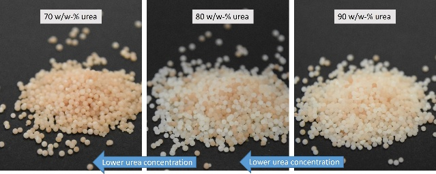
Figure 2: Pictures of fertilizer prills with potassium additive, from left to right; 70 w/w-% urea, 80 w/w-% urea, 90 w/w-% urea.
Around the world
All over the world agriculture struggles with a changing climate. In many industrialized countries the challenges of a changing climate are tackled through new and better fertilizing procedures which are engineered through better formulation and finishing technologies. In developing countries mechanization and automatization of agricultural is still low, making these countries more vulnerable. Industrial fertilizer products will become more and more important through increased mechanization and automatization of agriculture in these countries. Our goal is to help these countries profit from technology, infrastructure and training related to fertilizer in the coming years to help the agricultural sector reach increased productivity. [4]
Helping to make the first prill
With a changing fertilizer market starting new products or entering a new business area can be a task governed by uncertainty. Through a tight network many fertilizer producers try to leverage synergy from the fertilizer community by finding enablers and guides to stir the projects in the right direction, Many pitfalls can be avoided through exchange of information which will benefit the fertilizer finishing, formulation and production industry as a whole.
Through large consortia we are involved in the evaluation of the feasibility of stakeholder projects by comparing results to current industry standards and patented technologies outside the fertilizer business. The main challenge remains the decomposition of complex questions and finding solutions with academic partners and engineering institutes to make newest technologies available to the fertilizer industry.
Continuous improvement of prilling technology
Kreber has developed a closed loop prilling tower which will become the norm due to stricter environmental regulations, increased demand, higher productivity and product quality. What started as initiative to meet tighter emission regulations has become a valuable tool for tackling increased energy prices and meet customer requirements for prills.
Smart integration of the closed loop technology into existing prilling towers enables not only continued production when open loop systems are under pressure of legislation but also regain heat and energy through improved heat exchange. In the market we see that many fertilizer producers benefit from this technology, by identifying new freedom to operate and new operational windows which help to be better than the rest.
Driven by increased energy prices fertilizer producers make themselves more resilient for changing markets by incorporating adaptable prilling and formulation processes. This includes additive systems, to increase the nutrient portfolio or reduce the nitrogen content, optimized ventilation and filtration systems or more efficient collection systems. The revision of existing prillers to increase product quality, the installation of additional prillers to increase throughput or the increase of the tower efficiency are improvements where Kreber sees a lot of potential.
Leaping forward
At Kreber we know new technologies are not developed over night and proper planning and preparation is the key to success. We advise customers to start to test the feasibility of new technologies, assess and decide if they want to fold on their investment or continue through additional technological development stages, industrialization, equipment design and manufacturing. We have experienced that changes in formulations, feed stream or process parameters strongly influence the final product quality as well as the availability of the prilling equipment. We advise to first carry out feasibility studies, confirm literature data or evaluate the developed hypothesis.
We as experienced member in the fertilizer value chain assist companies and their R&D departments with these hurdles. They might involve but are not limited to initial lab experiments with standard equipment, the tailoring of equipment to meet the new parameters or the design of specific setups according to client requirements and specifications.
For fertilizer prill material analysis we use standard analytical equipment including but not limited to viscometers, x-ray powder diffraction, differential scanning calorimetry. We believe process analytical technology (PAT) and machine learning (ML) will find their way into the fertilizer industry soon and we promote these developments. We look into use of PAT to gain more information of chemical composition and distribution with including but not limited to mid- and near-infra-red spectroscopy, Raman spectroscopy, solid-state nuclear magnetic resonance as well as ML enhanced picture analysis. We use these analysis results through modelling and simulation to estimate process scaleup to reach final product quality and quantity. Such information can be used as input to identify the next steps.
Changes to the industry occur more frequently and to reduce time-to-market we make use of small or pilot scale equipment, as shown in figure 3. Here high product quality and comparable process parameters are the most important values to benchmark new developments and products. For small scale trials batches of up to 1000 kg are a suitable size to either probe the market or carry out studies in the field. Also production rates of 100 kg/h and less are suitable when it comes to up-scaling of lab developments.
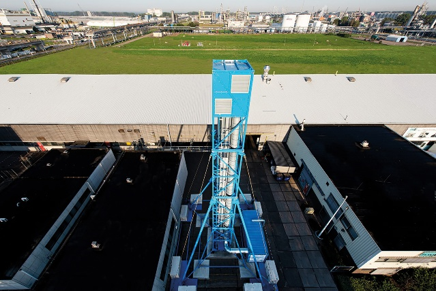
Figure 3: The Kreber pilot plant in the Europoort Rotterdam from a bird’s eye view.
We also see more and more down-scaling, where batch sizes or production rates are being reduced to increase product quality, adapt to niche markets or investigate large scale challenges under smaller, more controlled conditions without interrupting current production. It addition, down-scaling reduces the cost of experiments or helps outsource the process in general. This leads to the development of smaller equipment which can also be tailored to meet new regulations or specifications, like good manufacturing practise. Next to quality and reproducibility we aim for the seamless integration into existing or planned facilities to create synergy for large production sites.
Going beyond
Prilling technology has come a long way since its development. It has found application beyond the fertilizer industry by leaving the fertilizer comfort-zone and continuously adding new materials to the portfolio. To tackle the coming challenges of technology and nature, prilling will develop further. The challenges ahead are greater than the challenges of the past and we cannot predict all applications where prilling will overtake established technologies.
In the future, simple energy efficient equipment will gain more traction which also puts prilling in the spotlight to help meet the climate targets of nations around the world while ensuring food security. This not only means prilling of more complex products but also helping develop these products and identifying services from the fertilizer industry for the fertilizer industry. This may include prilling of pure substances, dispersions, slurries with up to 30 % solid content as well as polymers and fine chemicals under ATEX conditions.
Kreber has shaped and continues to shape the fertilizer value chain through our 50 years of prilling experience. Kreber’s equipment and solutions are designed for low maintenance, ensuring higher productivity and profitability for operators, contributing to global food security and sustainability. For Kreber efficient and high-quality equipment plays a crucial role in tackling future challenges and building a resilient future today.
References
- Harrison, David. Dream Lead to Invention. Bristol Times, 26 November 2002.
- Watts, Williams. Small Shot. 1347 United Kingdom, 10 December 1782.
- Morgen, Jennifer B. Connolly, Erin L. Plant-Soil Interactions: Nutrient Uptake, Nature Education 2013
- OECD-FAO. Agricultural Outlook 2023
- Hülsbergen ,Kurt-Jürgen; Schmid, Harald; Chmelikova, Lucie; Rahmann, Gerold; Paulsen, Hans Marten; Köpke, Ulrich. Umwelt- und Klimawirkungen des ökologischen Landbaus, Weihenstephaner Schriften Ökologischer Landbau und Pflanzenbausysteme, 01 2023